Jaun’s departure on his journey
Finnegans WakeJaun’s departure on his journey is a farewell and a theatrical send-off: Jaun announces a mission to meet Ireland’s overking, asks those left behind not to turn his going into a scene, and finally takes to the road. The departure moves from boastful speech through tears and communal praise to an abrupt, comic escape from the company watching him. Its destination is framed by a circular road and by the promise of return, so that leaving becomes both separation and another turn in the book’s recurrent passage between departure, memory, and homecoming.
The Mission and Its Circular Road
Jaun presents his journey as a mission of exceptional historical and national importance. He says he is leaving their “nostorey house” on a “benedictine errand,” and insists that it will be glorious through the annals of their “efferfreshpainted livy.” The grand announcement is immediately tethered to an intimate household: he asks that a message be given to his mother, and tells his listeners to tell her old one as well. The journey’s scale expands from a family departure into a claim about the whole life of Ireland.
That claim is given a geographical and historical hinge in the Vico road, which “goes round and round to meet where terms begin.” Jaun invokes this circular course as assurance that the travellers will remain serene and faithful to their duty; recurrence is not an obstacle to the mission but the shape that makes it imaginable. He says he is going to meet not an ordinary king but the overking of Ireland, and reaches still farther backward, to the time “Before there was patch at all on Ireland” when a lord lived at Lucan. His future-facing confidence is thus built from a past that already seems to contain the journey’s next turn.
A Farewell Meant to Govern the Mourners
Jaun’s speech is also an attempt to manage the emotions and conduct of those he leaves. He warns against scenes in his “poor primmafore’s wake” and imagines the company turning grief into noisy quarrels, gossip, and disorder. The mock-instructions keep the farewell comic, but they also expose its stakes: he knows his departure will be experienced as a loss and tries to dictate how that loss should be performed.
He answers grief with a promised future reunion. After the clouds have dispersed following their “forty years shower,” he imagines them “hooked and happy” together in a land beyond ordinary time. He urges the women to drink, announces that their paths must part, and recasts parting as something nearly festive. Yet the language cannot erase the separation. Jaun calls it a farewell, signs himself with a comic flourish, and ends the message as a letterman addressing readers who may search its lines for sense. The speech oscillates between tenderness, bravado, and deliberate verbal play rather than settling into solemn lament.
From Soapbox Orator to Vanishing Traveller
When Jaun later says it is time to be up and moving, his departure becomes physical. He imagines setting out with no saddle or staff, borrowing a path for wings, and travelling across the void world. The address grows into a rapid succession of farewells, places, and motion: he bids farewell to those around him, declares the sea his bride-to-be, and urges his companions onward. His language makes the journey sound at once improvised and ordained, a flight undertaken on the spur of the moment but carried by the momentum of ceremonial speech.
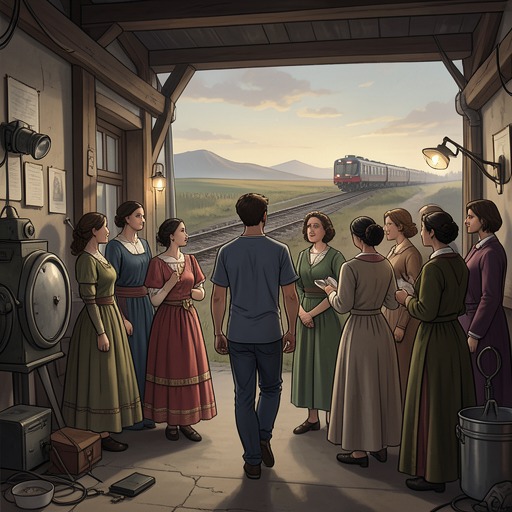
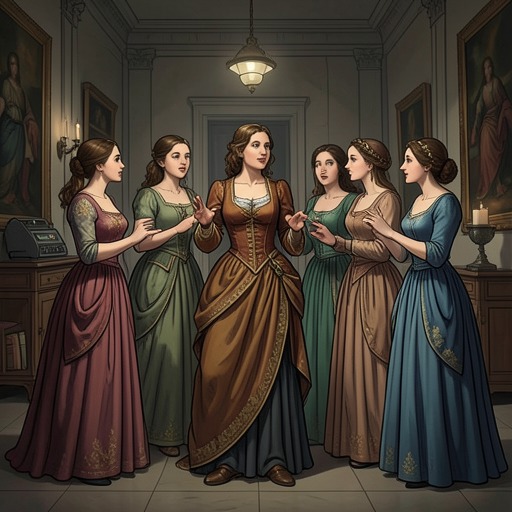
The audience gathers around the end of his soapbox performance. They are prepared either to cheer if he leaps or curse if he falls; instead, they see him give himself a prod or kick, sit up, and move. The crowd’s expectation of a fall gives way to tears and applause as the daughters of February Filldyke mourn and clap together. Jaun’s departure is therefore staged as a public spectacle whose watchers cannot decide whether they are witnessing a comic act, a loss, or a triumph.
The Yellow Label and the Escape
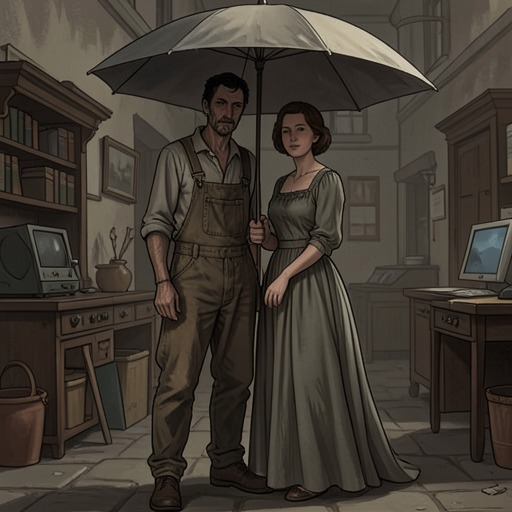
At the apparent point of departure, Jaun retrieves a familiar yellow label from a young woman. He lets a drop fall into it, smothers a curse, chokes a laugh, spits, blows his own trumpet, and stamps the oval badge of belief onto his forehead. The compact series of gestures makes the leave-taking a ritual assembled from bodily comedy and an emblematic mark. He then appears to wave across the sea as if giving notice of departure, before turning back toward the woman he loves and losing his balance.
The fall does not end in the river as the watchers expect. Jaun topples to one side, makes a fresh start, blesses his sisters with the sign of the southern cross, and runs. He narrowly avoids a bridge buttress near Ladycastle, then races along the road with the speed of a released hound. His fans’ good wishes arrive as packets and waves behind him, but he is quickly lost from sight among the statues. The sequence turns the threatened tumble into an escape: the man whom the crowd has watched and mourned leaves not by the expected solemn route, but by running beyond their sight.
Memory, Loss, and the Unfinished Return
After Jaun vanishes, the farewell becomes elegy. The voices left behind call him a songster and musician, praise his service, and lament that life will be blank without him. They imagine his light receding on a pilgrimage toward the past and hope that, after decades of suffering and brief glory, he may march home again. Their praise gives his departure the shape of a national as well as personal loss, while the hope of a return prevents that loss from closing into a final ending.
The sequence’s circular imagery and its public mourning remain deliberately unresolved. Jaun has declared an onward journey, and the crowd has seen him disappear down the road; the mourners, however, translate that disappearance into a possible return through the cycles of Irish history. Departure becomes an event repeatedly retold: first as Jaun’s own boastful mission, then as spectacle, and finally as the survivors’ account of a beloved figure already passing into memory. In that movement, the journey’s destination matters less than its recurring structure of leaving, vanishing, and being awaited again.